





Eye For Film >> Movies >> Daughters Of Darkness (1971) Film Review


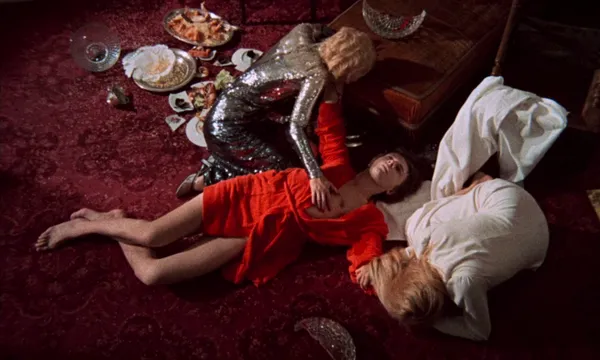

Harry Kümel's 1971 erotic horror Daughters Of Darkness is an early and artistic entry in the European cinema of lesbian vampire films. The film was designed to be commercial. The sex and nudity was there to pull in an audience, but unlike many others of its ilk it has substance, and a lot of style.
A young pair of newlyweds, Stefan (John Karlen) and Valerie (Danielle Ouimet) Chilton, are travelling by train to Stefan's ancestral home in England. After a fairly graphic sex scene, in an odd bit of pillow talk they tell each other that they don't love each other. The train grinds to a halt, an accident further up the tracks, forcing the couple to alight at Ostend. Planning only to overnight before continuing their journey, they book into the luxurious but deserted Thermae Palace. A little bit of trivia that plays into some of the film's themes is that the hotel opened in 1933, the year that the Nazis overthrew democracy in Germany.

Another couple arrive in a red Bristol 401, a bulbous, sensually lined 1940s classic: Countess Elizabeth Báthory (Delphine Seyrig) and Ilona (Andrea Rau). They are styled upon Marlene Dietrich and Louise Brooks respectively. Pierre (Paul Esser), the concierge, is somewhat disturbed on seeing the Countess. He remembers her from 40 years before. She looks just the same. The Countess becomes fascinated with the newlyweds. The following day Stefan and Valerie visit Bruges, a short trip from Ostend. There they witness the aftermath of a murder. Stefan is transfixed by the woman's corpse, forgetting the existence of his new bride. From here on in the characters' relationships play out through sexual dominance, cohesion and allusions to vampirism.
The colour palette that Kümel uses is striking: it is the red, black and white of German Nazism. The combination is there in almost every scene. These three colours are sharply delineated by soft browns and stone shades, which function within the film as something like dead space. The costumes that are worn by the four central characters take on one of the three colours according to the role that they are playing in terms of their relationships. A visual signal of dominance. Except sometimes for the Countess, a purple gown embellished with ostrich feathers for when she is pulling everyone else's strings, and, in the last part of the film, a long sequinned dress. She has just stridden straight out of Klimt's Golden phase (Klimt was, of course, long dead by the time fascists co-opted his art).
The characters' performances are exaggerated, melodramatic and play into the dreamlike logic of the film. Seyrig's performance is engaging and energetic. As Ilona, Andrea Rau conveys jaded apathy perfectly. It's a pairing that makes appearances again in the likes of Lestat and Louis in Anne Rice's 1976 novel Interview With A Vampire. There is an ominous supernatural feel about the whole piece which Kümel achieves without ever stepping outside the mundane. The sex and nudity in the film that first seems titillating becomes symbolic. It is reminiscent of the psychopathological novels of JG Ballard: Crash, High-Rise, The Atrocity Exhibition.
Daughters Of Darkness is often described as Gothic - it's got vampires so what else could it be? It is more Post-structuralist. The story is told more through symbols, the expressionist, the surreal, rather that through the harsh binary abstractions of language. Art Deco and the organic hothouse room of Stefan's mother (Fons Rademakers), divas of golden age Hollywood and fascist imaginary, Klimt, blood. Vampirism itself is symbolic. The only instance when blood is drunk is when Stefan lies on the ground cruciform: blood on his wrists, a perfect Jesus Christ pose.
Reviewed on: 27 Oct 2025


Director: Harry Kümel
Writer: Pierre Drouot, Jean Ferry, Harry Kümel
Starring: Delphine Seyrig, John Karlen, Danielle Ouimet, Andrea Rau, Paul Esser, Georges Jamin
Year: 1971
Runtime: 77 minutes
Country: Belgium, France, West Germany
Search database:
